


What Is Machine Learning and How Does It Work?
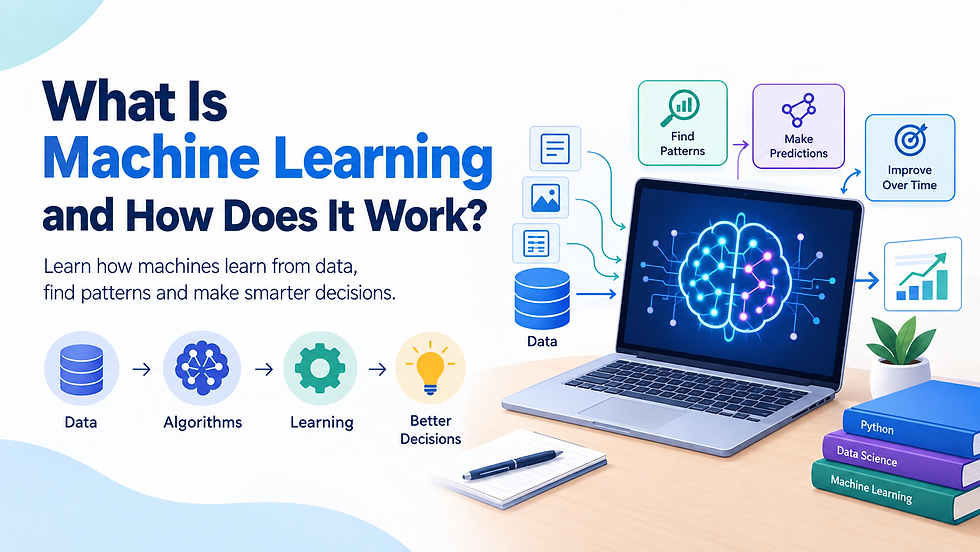
Machine learning is one of the most important technologies behind modern artificial intelligence. It allows computers to learn from data, identify patterns, and make predictions or decisions without being explicitly programmed for every task. From recommendation systems and voice assistants to fraud detection and healthcare applications, machine learning is becoming part of everyday life.
But What Is Machine Learning, and how does it actually work? This guide explains the concept, types, working process, applications, benefits, challenges, and future of machine learning in simple terms.
What Is Machine Learning?
Machine learning is a branch of artificial intelligence that enables computers to learn from data and improve their performance over time. Instead of relying only on fixed instructions, machine learning systems use algorithms to identify patterns within data and make predictions or decisions.
For example, a machine learning model can analyze thousands of emails to learn which messages are likely to be spam. After learning from previous examples, it can classify new emails automatically.
In simple terms, machine learning teaches computers to learn from experience and data rather than following instructions for every possible situation.
How Does Machine Learning Work?
Machine learning works by using data, algorithms, and statistical techniques to create models that can identify patterns. The process generally begins with collecting relevant data. This data is cleaned and prepared before being provided to a machine learning algorithm.
The algorithm analyzes the data and identifies relationships or patterns. During training, the model adjusts itself to improve its predictions. Once trained, the model is tested using new data to evaluate its performance.
If the results are satisfactory, the model can be deployed for real-world use. As new data becomes available, some systems can be retrained or updated to improve their accuracy.
Main Steps in Machine Learning
The machine learning process usually involves several important steps:
1. Data Collection
The first step is collecting useful and relevant data. Data can come from websites, applications, sensors, databases, transactions, surveys, or other sources.
2. Data Preparation
Raw data may contain missing values, duplicate records, errors, or unnecessary information. Data preparation involves cleaning and organizing the information so that it can be effectively used for training.
3. Feature Selection
Features are the characteristics or variables used by a model to identify patterns. Selecting useful features can help improve model performance and reduce unnecessary complexity.
4. Model Training
During training, a machine learning algorithm analyzes the prepared data and learns patterns or relationships. The model adjusts its parameters based on the available training examples.
5. Model Evaluation
The trained model is tested using data that it has not previously seen. Evaluation helps determine whether the model can make accurate predictions on new information.
6. Model Deployment
After successful testing, the model can be integrated into an application or business process. It can then make predictions or decisions using new data.
Types of Machine Learning
Machine learning is commonly divided into three major types.
Supervised Learning
Supervised learning uses labeled data. The model receives input information along with the correct output and learns the relationship between them.
For example, a model can learn from historical house prices and property features to predict the price of a new house. Classification and regression are common supervised learning tasks.
Unsupervised Learning
Unsupervised learning works with data that does not have predefined labels. The algorithm attempts to discover hidden patterns, groups, or relationships within the data.
Clustering is a common example. Businesses may use clustering to group customers according to purchasing behavior or interests.
Reinforcement Learning
Reinforcement learning involves an agent interacting with an environment and learning through rewards and penalties. The system attempts to find actions that maximize its long-term reward.
It is used in areas such as robotics, gaming, autonomous systems, and optimization.
Common Machine Learning Algorithms
Different machine learning problems require different algorithms. Some commonly used algorithms include:
Linear Regression: Used for predicting continuous numerical values.
Logistic Regression: Often used for classification problems.
Decision Trees: Make predictions using a tree-like structure of decisions.
Random Forest: Combines multiple decision trees to improve prediction performance.
Support Vector Machines: Used for classification and regression tasks.
K-Means Clustering: Groups similar data points into clusters.
Neural Networks: Models inspired by the structure of the human brain and widely used in complex AI applications.
The appropriate algorithm depends on the data, objective, complexity, and required level of accuracy.
Real-World Applications of Machine Learning
Machine learning is used across many industries and everyday technologies. Some common applications include:
Healthcare: Supporting disease detection, medical image analysis, and patient risk prediction.
Finance: Detecting fraudulent transactions and assessing financial risks.
E-commerce: Providing product recommendations and analyzing customer behavior.
Cybersecurity: Identifying unusual activity and potential security threats.
Marketing: Predicting customer preferences and improving campaign targeting.
Transportation: Supporting route optimization and intelligent transportation systems.
Entertainment: Recommending movies, music, videos, and other content.
Customer Service: Powering chatbots and automated support systems.
These applications demonstrate how machine learning can transform large amounts of data into useful insights.
Benefits of Machine Learning
Machine learning offers several advantages for businesses and organizations. One major benefit is automation. Systems can perform repetitive analytical tasks with limited human intervention.
Machine learning can also identify patterns in large datasets that may be difficult to discover manually. Businesses can use these insights to improve decision-making, personalize customer experiences, detect risks, and optimize operations.
Another advantage is scalability. Once a suitable model has been developed, it can process large amounts of new data efficiently.
However, the quality of machine learning results depends heavily on the quality and relevance of the data used to train the model.
Challenges of Machine Learning
Although machine learning has many benefits, it also presents several challenges.
Poor-quality or incomplete data can lead to inaccurate predictions. Another challenge is overfitting, where a model performs well on training data but struggles with new data.
Machine learning models can also be difficult to interpret, especially when complex algorithms are involved. This can create challenges for organizations that need transparent and explainable decisions.
Privacy, security, bias, computational costs, and ongoing model maintenance are additional considerations when implementing machine learning systems.
Machine Learning vs Traditional Programming
Traditional programming generally involves providing a computer with specific instructions and rules to produce an expected output. The programmer defines how the system should respond to different inputs.
Machine learning takes a different approach. Instead of manually creating rules for every situation, developers provide data and an appropriate algorithm. The system learns patterns from that data and uses the resulting model to generate predictions or decisions.
For example, traditional programming may use manually defined rules to identify spam emails. A machine learning system can learn spam patterns from thousands of previously classified emails.
This makes machine learning particularly useful for complex problems where creating rules manually would be difficult.
Skills Needed to Learn Machine Learning
People interested in machine learning can benefit from developing skills in several areas. Basic mathematics and statistics are important for understanding algorithms and evaluating models.
Programming knowledge, particularly Python, is also useful because many machine learning libraries and frameworks support it.
Other valuable skills include:
Data analysis
Statistics and probability
Linear algebra
Python programming
Data visualization
Machine learning algorithms
Model evaluation
Problem-solving
Database fundamentals
Practical projects are especially useful because they help learners understand how machine learning concepts are applied to real datasets.
Future of Machine Learning
The future of machine learning is closely connected with the growth of artificial intelligence, automation, and data-driven technologies. Organizations are increasingly using machine learning to improve products, services, and decision-making.
Advances in areas such as deep learning, natural language processing, computer vision, and generative AI are expanding what machine learning systems can accomplish.
At the same time, responsible development will remain important. Organizations need to consider data privacy, fairness, security, transparency, and human oversight when implementing machine learning solutions.
As technology continues to evolve, machine learning is expected to remain an important skill for technology professionals and businesses.
Conclusion:
Understanding What Is Machine Learning provides a foundation for exploring artificial intelligence and modern data-driven technologies. Machine learning enables computers to learn patterns from data and use those patterns to make predictions or decisions.
From supervised and unsupervised learning to reinforcement learning, different approaches can solve different types of problems. Its applications range from healthcare and finance to cybersecurity, marketing, e-commerce, and entertainment.
For beginners, learning programming, statistics, data analysis, and machine learning fundamentals can provide a strong starting point. With practical experience and continuous learning, machine learning can become a valuable technology skill for the future.
Frequently Asked Questions
What is machine learning in simple words?
Machine learning is a technology that allows computers to learn patterns from data and make predictions or decisions without requiring explicit instructions for every situation.
How does machine learning work?
Machine learning works by collecting and preparing data, training an algorithm, evaluating the resulting model, and using the trained model to make predictions on new data.
What are the three main types of machine learning?
The three main types are supervised learning, unsupervised learning, and reinforcement learning. Each approach uses data differently to solve specific problems.
Is machine learning difficult to learn?
Machine learning can be challenging initially because it combines programming, mathematics, statistics, and data analysis. Beginners can learn it gradually by starting with basic concepts and practical projects.
Is Python important for machine learning?
Yes. Python is widely used in machine learning because it has extensive libraries and frameworks for data analysis, visualization, model development, and artificial intelligence.
Where is machine learning used?
Machine learning is used in healthcare, finance, cybersecurity, e-commerce, marketing, transportation, entertainment, customer service, and many other fields.
What is the difference between AI and machine learning?
Artificial intelligence is a broader field focused on creating systems that perform tasks associated with human intelligence. Machine learning is a subset of AI that enables systems to learn from data.



Comments