


What Is Deep Learning? A Complete Beginner’s Guide

Artificial intelligence is transforming how people work, learn, communicate, and solve problems. From voice assistants and facial recognition to self-driving cars and intelligent chatbots, many modern technologies depend on advanced learning systems. One of the most important technologies behind these innovations is deep learning.
If you are wondering what deep learning is, how it works, and where it is used, this beginner-friendly guide explains the fundamentals in simple language. You will learn about neural networks, different types of deep learning models, real-world applications, benefits, challenges, and career opportunities.
Understanding deep learning can help students, professionals, and technology enthusiasts explore the growing fields of artificial intelligence and machine learning.
What Is Deep Learning?
Deep learning is a branch of artificial intelligence (AI) that uses artificial neural networks with multiple layers to learn patterns from large amounts of data. It enables computers to perform complex tasks, including recognizing images, understanding spoken language, generating text, and identifying unusual patterns.
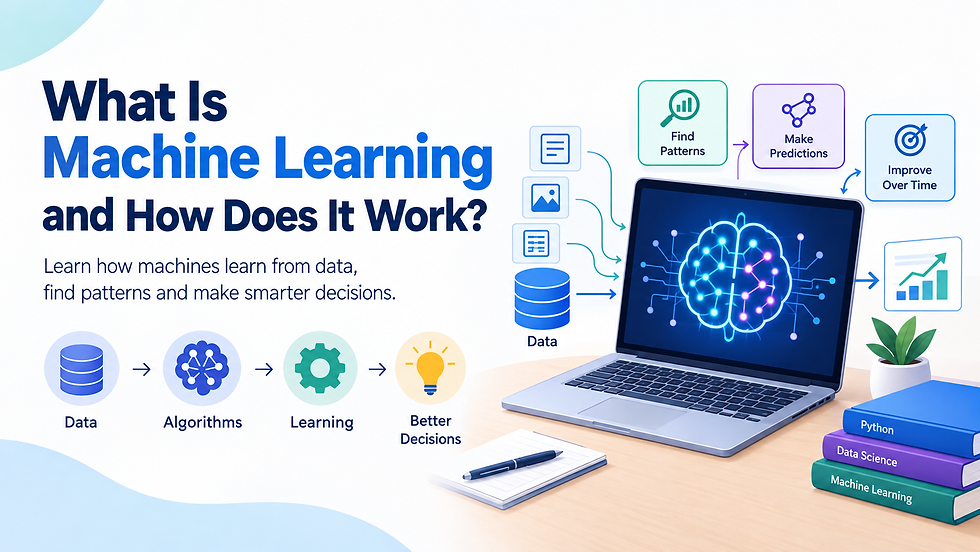
Deep learning is a specialized subset of machine learning. Traditional machine learning often requires people to select relevant features from data, while deep learning models can automatically learn useful representations during training.
For example, a deep learning model can learn to recognize cats in photographs by analyzing thousands or millions of example images. Over time, it identifies patterns such as shapes, textures, ears, and facial features.
Deep learning powers many technologies used in everyday life, including recommendation systems, virtual assistants, language translation, and generative AI tools.
Also Read: What Is Deep Learning
How Does Deep Learning Work?
Deep learning works by processing data through multiple layers of an artificial neural network. Each layer learns particular patterns and passes information to the next layer until the model produces an output.
The process generally involves the following steps:
Data collection: Gather relevant information, such as images, text, audio, or numerical records.
Data preparation: Clean and organize the data so the model can process it.
Model creation: Select an appropriate neural network architecture.
Training: Feed the data into the model and adjust its internal parameters to reduce prediction errors.
Evaluation: Test the model using data it has not seen during training.
Prediction: Use the trained model to analyze new information and generate results.
For example, a deep learning system trained on medical images may learn to identify patterns associated with certain conditions. Its performance depends on data quality, model design, and appropriate evaluation.
What Are Neural Networks?
Artificial neural networks are the foundation of deep learning. They are computational systems inspired loosely by the structure of biological brains.
A neural network typically contains three main types of layers:
Input layer: Receives information, such as image pixels, words, or numerical measurements.
Hidden layers: Process information and learn increasingly complex patterns. Deep learning models contain multiple hidden layers.
Output layer: Produces the final result, such as a classification, prediction, or generated response.
During training, the network compares its predictions with the expected results. An optimization process adjusts the network's parameters to reduce errors. Backpropagation is commonly used to calculate how parameters contribute to those errors.
With sufficient relevant data and suitable training, neural networks can learn complex relationships that are difficult to describe through manually written rules.
Types of Deep Learning
Different deep learning architectures are designed to solve different problems.
Convolutional Neural Networks (CNNs)
CNNs are particularly useful for image and video processing. They learn visual patterns, making them valuable for image classification, object detection, facial recognition, and medical image analysis.
Recurrent Neural Networks (RNNs)
RNNs were designed to process sequential information, such as time-series measurements, speech, and text. They can use information from earlier steps when processing a sequence. However, newer architectures have replaced them in many applications.
Transformers
Transformers use attention mechanisms to process relationships between elements in a sequence. They are widely used in large language models, translation systems, text generation, and many modern AI applications.
Generative Adversarial Networks (GANs)
GANs use two competing neural networks: a generator and a discriminator. They can learn to produce realistic synthetic images and other types of data.
Autoencoders
Autoencoders learn compressed representations of data and attempt to reconstruct the original input. They can support dimensionality reduction, feature learning, and anomaly detection.
Applications of Deep Learning
Deep learning has applications across many industries because it can analyze complex data and recognize patterns.
Healthcare: Supports medical image analysis, research, and certain diagnostic workflows.
Finance: Helps detect suspicious transaction patterns and assess potential fraud.
Education: Enables personalized learning tools, automated feedback, and intelligent tutoring applications.
Retail and e-commerce: Powers product recommendations, demand forecasting, and visual product searches.
Transportation: Supports driver-assistance systems, object detection, and autonomous-driving research.
Cybersecurity: Helps identify unusual network activity, suspicious behavior, and potential threats.
Natural language processing: Enables text summarization, translation, chatbots, and question-answering systems.
Manufacturing: Supports quality inspection, predictive maintenance, and defect detection.
Although deep learning can improve efficiency, its predictions should be evaluated carefully, especially when mistakes could affect people's safety, finances, or access to essential services.
Benefits of Deep Learning
Deep learning offers several advantages for organizations and technology developers.
Automatic feature learning: Models can learn useful patterns directly from raw or minimally processed data.
High performance on complex tasks: Deep learning can perform well in image recognition, speech processing, language understanding, and other demanding applications.
Scalability: Many deep learning systems can improve as they receive more relevant training data and computational resources, although improvement is not guaranteed.
Automation: Deep learning can automate repetitive analysis and help people make informed decisions.
Versatility: Similar underlying techniques can be adapted to many industries and data types.
These benefits make deep learning an important part of modern AI development. However, results depend on the problem, data quality, training methods, and available resources.
Challenges and Limitations of Deep Learning
Despite its capabilities, deep learning has limitations that beginners should understand.
High computational requirements: Training large models can require powerful processors, specialized hardware, and substantial electricity.
Large data requirements: Many applications need considerable amounts of representative training data.
Limited interpretability: Understanding why a complex model produces a particular prediction can be difficult.
Bias and fairness concerns: Models can reproduce biases present in their training data.
Overfitting: A model may perform well on training data but poorly on unfamiliar examples.
Privacy and security risks: Sensitive training data and deployed models require appropriate protection.
Organizations can reduce these risks through careful data management, independent testing, monitoring, and responsible AI practices.
Deep Learning vs. Machine Learning
Machine learning and deep learning are closely related, but they are not identical.
Machine learning includes methods such as decision trees, linear regression, support vector machines, and neural networks. Deep learning focuses on neural networks with multiple layers.
Traditional machine learning methods can work well with smaller datasets and structured information. Deep learning is often particularly useful for complex data, including images, audio, video, and natural language.
For example, a traditional machine learning project might rely on manually selected features to classify customer behavior. A deep learning project could learn complex representations from raw data, provided sufficient examples and computational resources are available.
The best approach depends on the task, available data, performance requirements, interpretability needs, and project budget.
Skills Required to Learn Deep Learning
Beginners can build a strong foundation by developing several technical skills.
Python programming: Learn variables, functions, data structures, and basic programming concepts.
Mathematics: Understand linear algebra, probability, statistics, and basic calculus.
Machine learning fundamentals: Study supervised learning, model evaluation, and overfitting.
Data handling: Practice working with datasets using tools such as NumPy and pandas.
Deep learning frameworks: Explore PyTorch or TensorFlow to build and train neural networks.
Problem-solving: Learn how to experiment, interpret results, and improve models.
You do not need to master every topic before starting. Begin with programming and basic machine learning, then gradually move toward neural networks and practical projects.
Career Opportunities in Deep Learning
Deep learning skills can support careers in artificial intelligence, data science, software engineering, and research.
Potential roles include:
Deep Learning Engineer
Machine Learning Engineer
AI Engineer
Data Scientist
Computer Vision Engineer
Natural Language Processing Engineer
AI Research Scientist
Job requirements vary by employer. Some positions prioritize software development and model deployment, while research-oriented roles may require advanced mathematics and postgraduate qualifications.
Building a portfolio with practical projects can help demonstrate your skills. Examples include creating an image classifier, developing a text classification model, or building a simple recommendation system.
As AI adoption expands, professionals who combine technical knowledge with problem-solving and responsible development practices may find opportunities across multiple industries.
How to Get Started with Deep Learning
If you are new to deep learning, follow a structured learning path.
Step 1: Learn Python. Practice writing small programs and manipulating datasets.
Step 2: Study the fundamentals. Build an understanding of machine learning, statistics, and basic linear algebra.
Step 3: Understand neural networks. Learn about layers, activation functions, loss functions, and optimization.
Step 4: Choose a framework. Start with PyTorch or TensorFlow and complete introductory tutorials.
Step 5: Build small projects. Train a basic image classifier or sentiment analysis model.
Step 6: Explore advanced topics. Study CNNs, transformers, generative models, and model deployment as your skills improve.
Consistent practice is more effective than trying to learn every deep learning concept at once. Document your projects and explain the problems your models solve.
Conclusion:
Deep learning is a major branch of artificial intelligence that enables computers to learn complex patterns using multilayer neural networks. It supports a wide range of technologies, from image recognition and speech processing to chatbots and generative AI.
For beginners, the best way to understand deep learning is to start with Python, learn the basics of machine learning, explore neural networks, and build small projects. Although the field presents challenges involving data, computing resources, and model transparency, it offers valuable opportunities for learning and innovation.
By developing practical skills and understanding responsible AI practices, you can establish a strong foundation for exploring deep learning and pursuing opportunities in the growing artificial intelligence industry.
Frequently Asked Questions
What is deep learning in simple words?
Deep learning is a type of artificial intelligence that uses neural networks with multiple layers to learn patterns from data and make predictions or generate content.
Is deep learning a part of machine learning?
Yes. Deep learning is a subset of machine learning that uses multilayer neural networks to learn complex patterns.
Do I need coding skills to learn deep learning?
Basic programming knowledge is highly recommended. Python is a popular starting point because it has many libraries for machine learning and neural networks.
Is deep learning difficult for beginners?
It can be challenging because it involves programming, mathematics, and model training. However, beginners can learn it gradually through tutorials and practical projects.
What is the difference between AI and deep learning?
Artificial intelligence is the broader field of building systems that perform intelligent tasks. Deep learning is one approach within machine learning, which is itself a subset of AI.
Where is deep learning used?
Deep learning is used in healthcare, finance, education, cybersecurity, transportation, manufacturing, image recognition, and language-processing applications.



Comments