


What Are the Benefits of Generative AI For Businesses and Individuals?

Generative AI is changing how businesses and individuals create content, analyze information, solve problems, and complete everyday tasks. From writing and coding to customer support and data analysis, generative AI can improve productivity while reducing repetitive work. As these technologies continue to develop, understanding their practical benefits is becoming increasingly important.
This article explains the key benefits of generative AI for businesses and individuals and explores how it connects with the Benefits of Generative AI.
What Is Generative AI?
Generative AI is a type of artificial intelligence that can create new content based on user instructions and learned patterns. It can generate text, images, computer code, audio, video, summaries, and other forms of content.
Unlike traditional AI systems that mainly classify or predict information, generative AI focuses on producing new outputs. Businesses can use it for automation and productivity, while individuals can use it for learning, creativity, communication, and everyday tasks.
How Does Generative AI Work?
Generative AI models are trained using large amounts of data to recognize patterns and relationships. When a user provides a prompt, the system processes the request and generates an output based on its training and model capabilities.
Large language models are commonly used for text-based applications. Other generative models can work with images, audio, video, and code. The quality of the result depends on the model, training data, instructions, and human review.
Benefits of Generative AI for Businesses
Businesses across different industries can use generative AI to automate repetitive activities and support employees. It can assist with marketing content, customer communication, software development, research, documentation, and data-related tasks.
The technology can also help organizations experiment with new ideas more quickly. When implemented responsibly, generative AI can complement human expertise rather than simply replace existing workflows.
Increased Productivity
One of the major benefits of generative AI is improved productivity. Employees can use AI tools to draft documents, summarize information, generate ideas, prepare reports, and assist with routine communication.
By reducing the amount of time spent on repetitive activities, employees can focus more on strategic, creative, and decision-making work. Businesses can integrate generative AI into existing workflows to help teams complete certain tasks more efficiently.
Faster Content Creation
Generative AI can help businesses create first drafts of blogs, emails, product descriptions, social media posts, presentations, and marketing materials.
It can also help individuals brainstorm topics, improve writing, summarize lengthy information, and organize ideas. Human review remains important because AI-generated content may contain inaccurate, incomplete, or inappropriate information.
Improved Customer Experience
Generative AI can support customer service through conversational assistants and automated response systems. These systems can help answer common questions, provide information, and guide customers through routine processes.
Businesses can also use AI to create personalized communications based on customer interactions and available data. Human support remains valuable for complex, sensitive, or unusual customer issues.
Cost and Time Savings
Automation can reduce the amount of manual effort required for repetitive tasks. Generative AI can assist employees with research, documentation, communication, coding, and content development.
These efficiencies may help organizations use their resources more effectively. However, businesses should consider implementation, training, security, infrastructure, and human oversight costs before expecting direct financial savings.
Better Data Analysis
Generative AI can make data-related work easier by helping users understand complex information. It can summarize datasets, explain analytical concepts, generate SQL queries, assist with code, and help users explore possible insights.
Data scientists can use generative AI as an assistant during parts of the analytical workflow. Human validation is still necessary because AI-generated calculations, code, and interpretations can contain errors.
Support for Innovation
Generative AI can help businesses explore new products, services, campaigns, and business ideas. Teams can quickly create prototypes, generate alternative concepts, and test different approaches.
For example, a product team can use AI to brainstorm features, while a marketing team can explore multiple campaign concepts. This can shorten early experimentation cycles and encourage broader idea generation.
Benefits of Generative AI for Individuals
Individuals can use generative AI as a personal productivity and learning assistant. It can help with writing, brainstorming, research, coding, studying, planning, and communication.
Students and professionals can use AI to explain difficult concepts, create practice questions, organize notes, and improve drafts. However, users should verify important information and avoid relying on AI as the sole source for high-stakes decisions.
Personalized Learning
Generative AI can adapt explanations to different levels of knowledge. A learner can ask for a simple explanation, an advanced explanation, examples, practice exercises, or a step-by-step breakdown of a topic.
This flexibility can make learning more interactive. AI can also help users identify areas they need to practice, although educators and reliable learning resources remain important for accurate and comprehensive education.
Improved Creativity
Generative AI can act as a brainstorming partner for writers, designers, marketers, developers, and other creative professionals. It can generate ideas, variations, outlines, concepts, and starting points.
The final creative direction can still come from the individual. Instead of replacing creativity, AI can help people overcome blank-page problems and explore possibilities more quickly.
Assistance With Everyday Tasks
Individuals can use generative AI for many routine activities, such as drafting emails, organizing information, creating schedules, summarizing documents, preparing checklists, and explaining technical instructions.
This can reduce the effort required for everyday digital tasks. Users should avoid entering confidential or sensitive information into AI systems unless they understand the platform's privacy and data-handling practices.
Generative AI in Data Science
Generative AI is becoming increasingly relevant to data science. Data professionals can use AI assistants for coding, SQL development, documentation, exploratory analysis, visualization suggestions, and communicating technical findings.
It can also help non-technical users interact with data through natural-language prompts. This may make analytical tools more accessible while increasing the importance of data quality, validation, privacy, and responsible AI practices.
Future of Data Science and Generative AI
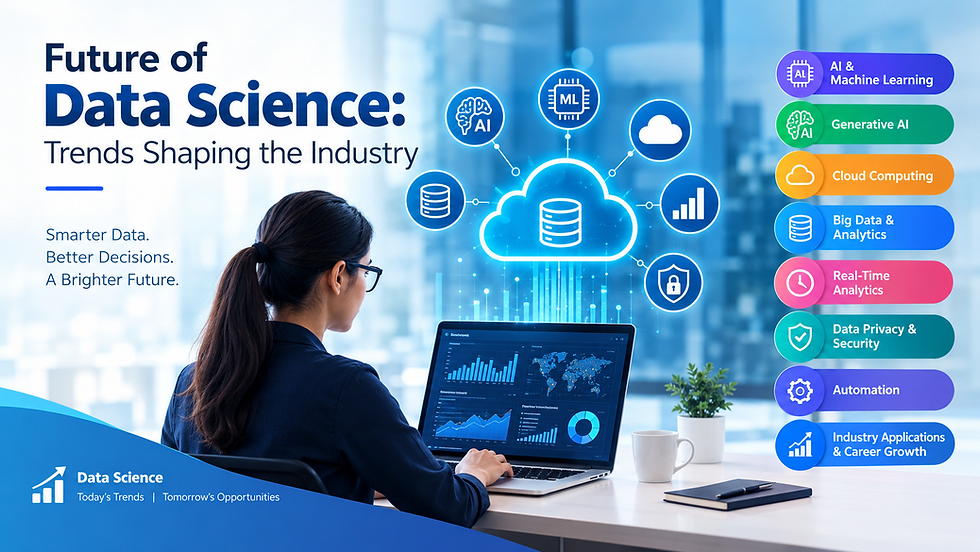
The Future of Data Science is closely connected to advances in artificial intelligence, automation, cloud computing, and generative models. Data scientists are increasingly expected to work with AI-powered tools while maintaining strong foundations in statistics, programming, data engineering, and business understanding.
Generative AI may automate portions of routine analytical work, allowing professionals to spend more time on problem definition, model evaluation, interpretation, and strategic decision-making.
Challenges of Generative AI
Despite its benefits, generative AI has limitations. AI systems can produce inaccurate information, biased outputs, fabricated references, or insecure code. Businesses also need to consider data privacy, intellectual property, cybersecurity, and regulatory requirements.
Organizations should establish clear AI policies and implement appropriate human oversight. Users should verify important outputs before using them in professional, financial, legal, medical, or other high-impact situations.
How Businesses Can Adopt Generative AI
Businesses can begin by identifying repetitive tasks where AI assistance could provide measurable value. They can then select appropriate tools, establish security guidelines, train employees, and introduce human review processes.
Starting with controlled use cases can help organizations understand the technology before expanding its use. Performance should be monitored through relevant measures such as productivity, accuracy, quality, user satisfaction, and cost.
Conclusion:
Generative AI offers practical benefits for both businesses and individuals. It can support productivity, content creation, customer service, learning, creativity, data analysis, and innovation.
At the same time, successful adoption requires responsible use, human oversight, data protection, and continuous evaluation. As AI capabilities develop, generative AI is likely to remain an important part of the Benefits of Generative AI, helping professionals work with information and technology in new ways.
Frequently Asked Questions
What are the main benefits of generative AI for businesses?
Generative AI can help businesses improve productivity, automate repetitive work, create content, support customers, analyze information, and accelerate innovation.
How can individuals use generative AI?
Individuals can use generative AI for learning, writing, brainstorming, coding, research, planning, summarization, and other everyday productivity tasks.
Is generative AI useful for data science?
Yes. It can assist with coding, SQL queries, documentation, data exploration, analysis, and communicating technical results, while human validation remains essential.
Will generative AI replace data scientists?
Generative AI can automate some routine tasks, but data science also requires problem-solving, statistical reasoning, domain knowledge, data interpretation, and responsible decision-making.
What is the Future of Data Science?
The Future of Data Science is expected to involve greater integration of AI, generative AI, automation, cloud technologies, advanced analytics, and human expertise.
What are the risks of generative AI?
Common concerns include inaccurate outputs, bias, privacy issues, cybersecurity risks, intellectual property concerns, and inappropriate reliance on AI-generated information.


Comments