


Generative AI vs Machine Learning: A Practical Guide For Modern Enterprises
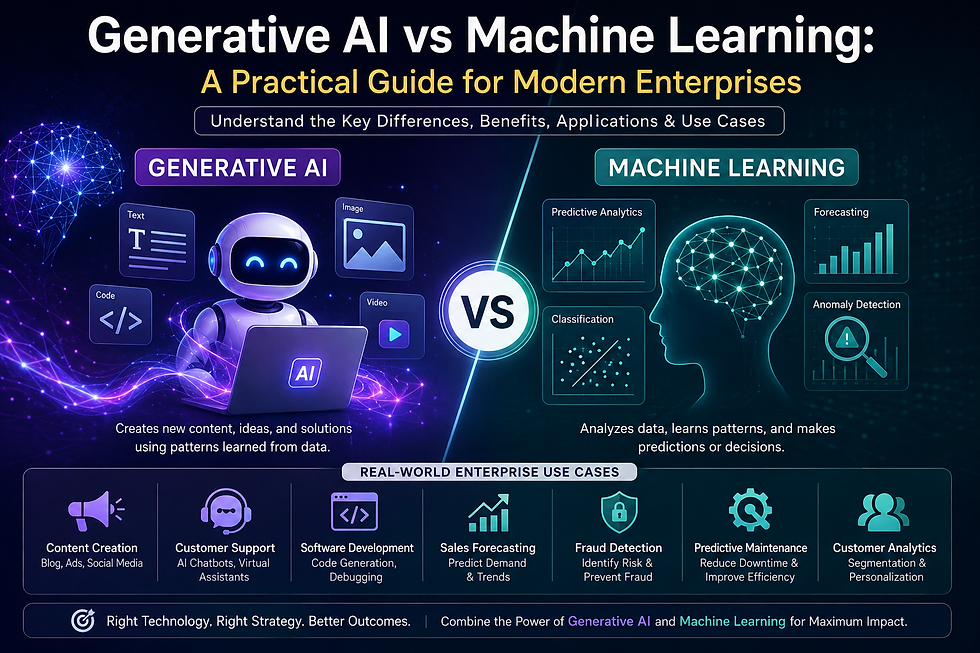
Artificial intelligence (AI) is transforming how businesses operate, innovate, and compete in today's digital economy. Among the most discussed AI technologies are Generative AI vs Machine Learning, two powerful approaches that help organizations automate tasks, improve decision-making, and create new business opportunities. Although these terms are often used interchangeably, they serve different purposes and solve different types of problems.
Machine Learning (ML) has been a cornerstone of AI for years, enabling computers to learn from historical data and make predictions without being explicitly programmed. Generative AI, on the other hand, represents the latest evolution of AI, capable of creating original content such as text, images, videos, code, music, and even product designs.
Understanding Generative AI vs Machine Learning is essential for modern enterprises looking to invest in AI technologies. Choosing the right solution depends on business objectives, available data, implementation costs, and expected outcomes. While Machine Learning excels at prediction and pattern recognition, Generative AI focuses on creativity and content generation.
This guide explores the major differences, technologies, and business applications of both approaches, helping organizations determine which solution best fits their digital transformation strategy.
What Is Generative AI?
Generative AI is a branch of artificial intelligence that creates entirely new content by learning patterns from existing data. Instead of simply identifying trends or making predictions, Generative AI generates human-like outputs, including written articles, realistic images, software code, marketing copy, videos, music, and conversational responses.
Unlike traditional AI systems that classify or analyze information, Generative AI produces something original. It uses advanced deep learning architectures trained on massive datasets to understand language, visuals, and complex relationships.
Modern Generative AI systems rely on neural networks capable of recognizing context, structure, and semantics. This enables them to generate responses that closely resemble human creativity.
Key Characteristics of Generative AI
Produces original content
Learns from large datasets
Supports text, images, audio, video, and code generation
Continuously improves through training
Automates creative workflows
Businesses across industries are adopting Generative AI to increase productivity and reduce operational costs. Marketing teams use it to create content, software companies generate code, healthcare providers summarize medical records, and customer service teams deploy AI-powered chatbots.
Popular Generative AI Technologies
Some of the most widely used Generative AI technologies include:
Large Language Models (LLMs)
Diffusion Models
Generative Adversarial Networks (GANs)
Transformer Models
Foundation Models
These technologies have significantly expanded what AI can accomplish, making Generative AI one of the fastest-growing enterprise technologies.
What Is Machine Learning?
Machine Learning is a subset of artificial intelligence that enables computers to learn from historical data without being explicitly programmed. Instead of following fixed rules, Machine Learning algorithms analyze data, identify patterns, and make predictions based on previous experiences.
Machine Learning focuses primarily on prediction, classification, recommendation, anomaly detection, and decision-making rather than content creation.
Businesses have been using Machine Learning for decades to optimize operations, improve customer experiences, detect fraud, forecast demand, and automate repetitive decision-making tasks.
How Machine Learning Learns
Machine Learning systems improve their performance as they process more data. During training, algorithms identify relationships between inputs and outputs. Once trained, they apply this knowledge to unseen data.
For example:
Email spam filters learn which messages are spam.
Banking systems detect fraudulent transactions.
Streaming platforms recommend movies.
Retailers forecast future sales.
Healthcare organizations predict disease risks.
Key Characteristics of Machine Learning
Learns from historical data
Predicts future outcomes
Identifies hidden patterns
Improves accuracy over time
Supports data-driven decision making
Machine Learning remains one of the most valuable technologies for enterprises because it transforms large volumes of business data into actionable insights.
Generative AI vs Machine Learning: Key Differences Explained
Although both technologies belong to artificial intelligence, understanding Generative AI vs Machine Learning requires recognizing their different objectives, outputs, and business value.
Feature | Generative AI | Machine Learning |
Primary Goal | Create new content | Predict outcomes |
Output | Text, images, videos, code | Predictions, classifications |
Training Data | Massive datasets | Structured business data |
Main Focus | Creativity | Pattern recognition |
Business Use | Content generation | Decision support |
Examples | AI writing, image generation | Fraud detection, forecasting |
Purpose
Machine Learning identifies patterns and makes predictions.
Generative AI creates entirely new content using learned knowledge.
Output
Machine Learning provides predictions, recommendations, or classifications.
Generative AI produces articles, images, videos, software code, reports, presentations, and more.
Complexity
Generative AI often requires significantly larger datasets and computational resources than traditional Machine Learning models.
Business Value
Machine Learning helps enterprises optimize operations.
Generative AI accelerates creativity, automation, innovation, and employee productivity.
Understanding these differences helps businesses choose the right AI investment for their specific needs.
How Generative AI Works
Generative AI operates using advanced deep learning models trained on enormous datasets containing text, images, videos, audio, and other forms of digital content. During training, the model learns relationships, language structures, visual patterns, and contextual meanings.
Rather than memorizing information, Generative AI predicts the most likely sequence of words, pixels, or data elements based on the input it receives.
The Generative AI Workflow
Step 1: Data Collection
Large datasets containing billions of examples are gathered for training.
Step 2: Model Training
Deep neural networks analyze these datasets to understand patterns, grammar, context, and relationships.
Step 3: Prompt Processing
A user provides a prompt or instruction.
Example:
Write a blog
Generate an image
Create software code
Summarize a document
Step 4: Content Generation
The AI predicts and generates the most appropriate response based on everything it has learned during training.
Step 5: Continuous Improvement
Many enterprise AI systems are fine-tuned using domain-specific datasets, feedback loops, and reinforcement learning to improve accuracy and relevance over time.
Core Technologies Behind Generative AI
Several advanced technologies power today's Generative AI systems:
Deep Learning
Neural Networks
Transformer Architecture
Large Language Models (LLMs)
Diffusion Models
Generative Adversarial Networks (GANs)
Reinforcement Learning from Human Feedback (RLHF)
Enterprise Benefits of Generative AI
Organizations are adopting Generative AI because it enables them to:
Produce content faster
Improve employee productivity
Automate repetitive creative tasks
Accelerate software development
Enhance customer support
Generate personalized marketing campaigns
Reduce operational costs
Improve innovation speed
As businesses continue investing in AI-driven transformation, understanding Generative AI vs Machine Learning becomes increasingly important. While Machine Learning remains the preferred choice for predictive analytics, Generative AI is redefining how enterprises create, communicate, and innovate.
Artificial intelligence (AI) is transforming how businesses operate, innovate, and compete in today's digital economy. Among the most discussed AI technologies are Generative AI vs Machine Learning, two powerful approaches that help organizations automate tasks, improve decision-making, and create new business opportunities. Although these terms are often used interchangeably, they serve different purposes and solve different types of problems.
Machine Learning (ML) has been a cornerstone of AI for years, enabling computers to learn from historical data and make predictions without being explicitly programmed. Generative AI, on the other hand, represents the latest evolution of AI, capable of creating original content such as text, images, videos, code, music, and even product designs.
Understanding Generative AI vs Machine Learning is essential for modern enterprises looking to invest in AI technologies. Choosing the right solution depends on business objectives, available data, implementation costs, and expected outcomes. While Machine Learning excels at prediction and pattern recognition, Generative AI focuses on creativity and content generation.
This guide explores the major differences, technologies, and business applications of both approaches, helping organizations determine which solution best fits their digital transformation strategy.
What Is Generative AI?
Generative AI is a branch of artificial intelligence that creates entirely new content by learning patterns from existing data. Instead of simply identifying trends or making predictions, Generative AI generates human-like outputs, including written articles, realistic images, software code, marketing copy, videos, music, and conversational responses.
Unlike traditional AI systems that classify or analyze information, Generative AI produces something original. It uses advanced deep learning architectures trained on massive datasets to understand language, visuals, and complex relationships.
Modern Generative AI systems rely on neural networks capable of recognizing context, structure, and semantics. This enables them to generate responses that closely resemble human creativity.
Key Characteristics of Generative AI
Produces original content
Learns from large datasets
Supports text, images, audio, video, and code generation
Continuously improves through training
Automates creative workflows
Businesses across industries are adopting Generative AI to increase productivity and reduce operational costs. Marketing teams use it to create content, software companies generate code, healthcare providers summarize medical records, and customer service teams deploy AI-powered chatbots.
Popular Generative AI Technologies
Some of the most widely used Generative AI technologies include:
Large Language Models (LLMs)
Diffusion Models
Generative Adversarial Networks (GANs)
Transformer Models
Foundation Models
These technologies have significantly expanded what AI can accomplish, making Generative AI one of the fastest-growing enterprise technologies.
What Is Machine Learning?
Machine Learning is a subset of artificial intelligence that enables computers to learn from historical data without being explicitly programmed. Instead of following fixed rules, Machine Learning algorithms analyze data, identify patterns, and make predictions based on previous experiences.
Machine Learning focuses primarily on prediction, classification, recommendation, anomaly detection, and decision-making rather than content creation.
Businesses have been using Machine Learning for decades to optimize operations, improve customer experiences, detect fraud, forecast demand, and automate repetitive decision-making tasks.
How Machine Learning Learns
Machine Learning systems improve their performance as they process more data. During training, algorithms identify relationships between inputs and outputs. Once trained, they apply this knowledge to unseen data.
For example:
Email spam filters learn which messages are spam.
Banking systems detect fraudulent transactions.
Streaming platforms recommend movies.
Retailers forecast future sales.
Healthcare organizations predict disease risks.
Key Characteristics of Machine Learning
Learns from historical data
Predicts future outcomes
Identifies hidden patterns
Improves accuracy over time
Supports data-driven decision making
Machine Learning remains one of the most valuable technologies for enterprises because it transforms large volumes of business data into actionable insights.
Generative AI vs Machine Learning: Key Differences Explained
Although both technologies belong to artificial intelligence, understanding Generative AI vs Machine Learning requires recognizing their different objectives, outputs, and business value.
Feature | Generative AI | Machine Learning |
Primary Goal | Create new content | Predict outcomes |
Output | Text, images, videos, code | Predictions, classifications |
Training Data | Massive datasets | Structured business data |
Main Focus | Creativity | Pattern recognition |
Business Use | Content generation | Decision support |
Examples | AI writing, image generation | Fraud detection, forecasting |
Purpose
Machine Learning identifies patterns and makes predictions.
Generative AI creates entirely new content using learned knowledge.
Output
Machine Learning provides predictions, recommendations, or classifications.
Generative AI produces articles, images, videos, software code, reports, presentations, and more.
Complexity
Generative AI often requires significantly larger datasets and computational resources than traditional Machine Learning models.
Business Value
Machine Learning helps enterprises optimize operations.
Generative AI accelerates creativity, automation, innovation, and employee productivity.
Understanding these differences helps businesses choose the right AI investment for their specific needs.
How Generative AI Works
Generative AI operates using advanced deep learning models trained on enormous datasets containing text, images, videos, audio, and other forms of digital content. During training, the model learns relationships, language structures, visual patterns, and contextual meanings.
Rather than memorizing information, Generative AI predicts the most likely sequence of words, pixels, or data elements based on the input it receives.
The Generative AI Workflow
Step 1: Data Collection
Large datasets containing billions of examples are gathered for training.
Step 2: Model Training
Deep neural networks analyze these datasets to understand patterns, grammar, context, and relationships.
Step 3: Prompt Processing
A user provides a prompt or instruction.
Example:
Write a blog
Generate an image
Create software code
Summarize a document
Step 4: Content Generation
The AI predicts and generates the most appropriate response based on everything it has learned during training.
Step 5: Continuous Improvement
Many enterprise AI systems are fine-tuned using domain-specific datasets, feedback loops, and reinforcement learning to improve accuracy and relevance over time.
Core Technologies Behind Generative AI
Several advanced technologies power today's Generative AI systems:
Deep Learning
Neural Networks
Transformer Architecture
Large Language Models (LLMs)
Diffusion Models
Generative Adversarial Networks (GANs)
Reinforcement Learning from Human Feedback (RLHF)
Enterprise Benefits of Generative AI
Organizations are adopting Generative AI because it enables them to:
Produce content faster
Improve employee productivity
Automate repetitive creative tasks
Accelerate software development
Enhance customer support
Generate personalized marketing campaigns
Reduce operational costs
Improve innovation speed
As businesses continue investing in AI-driven transformation, understanding Generative AI vs Machine Learning becomes increasingly important. While Machine Learning remains the preferred choice for predictive analytics, Generative AI is redefining how enterprises create, communicate, and innovate.
Benefits of Generative AI for Modern Enterprises
Generative AI is transforming how businesses innovate, communicate, and operate. Unlike traditional AI systems that focus on analyzing data, Generative AI creates original content such as text, images, videos, software code, and product designs. This capability enables organizations to improve productivity, reduce costs, and accelerate digital transformation.
One of the biggest advantages of Generative AI is its ability to automate content creation. Marketing teams can generate blog posts, product descriptions, social media content, email campaigns, and advertising copy in minutes rather than hours. This significantly reduces manual effort while maintaining consistency across communication channels.
Customer service is another area where Generative AI delivers substantial value. AI-powered virtual assistants and chatbots provide instant, personalized responses to customer inquiries, improving satisfaction while reducing support costs. These systems operate 24/7, ensuring businesses can serve customers around the clock.
Software development teams also benefit from Generative AI. Developers can use AI tools to generate code snippets, detect programming errors, write technical documentation, and automate repetitive coding tasks. This speeds up software development and allows engineers to focus on solving complex business problems.
Key Benefits of Generative AI
Accelerates content creation
Enhances customer engagement
Improves employee productivity
Automates repetitive workflows
Supports faster product development
Reduces operational costs
Enables personalized customer experiences
Encourages innovation
Improves knowledge management
Scales business operations efficiently
Another major benefit is personalization. Generative AI analyzes customer preferences to create personalized product recommendations, marketing campaigns, and communication. This increases customer satisfaction and improves conversion rates.
Enterprises also use Generative AI for document summarization, meeting notes, report generation, proposal writing, contract drafting, and internal knowledge management. These capabilities help employees save time and improve decision-making.
As organizations continue investing in AI-driven transformation, Generative AI is becoming an essential technology for improving efficiency, creativity, and competitiveness.
Advantages of Machine Learning in Business Operations
Machine Learning has become a critical technology for organizations seeking to make data-driven decisions. By analyzing historical data, Machine Learning models identify hidden patterns and generate predictions that help businesses optimize operations and reduce risks.
One of the greatest strengths of Machine Learning is predictive analytics. Businesses can forecast customer demand, estimate future sales, identify equipment failures, and anticipate market trends before they occur. These insights enable organizations to make proactive decisions instead of reacting to problems.
Financial institutions use Machine Learning to detect fraudulent transactions in real time. By continuously monitoring customer behavior, ML models quickly identify suspicious activities that would be difficult for humans to detect manually.
Retail companies use Machine Learning to recommend products based on browsing history and purchase behavior. Personalized recommendations improve customer satisfaction while increasing revenue.
Major Advantages of Machine Learning
Accurate business forecasting
Data-driven decision-making
Fraud detection
Customer behavior analysis
Inventory optimization
Predictive maintenance
Process automation
Improved operational efficiency
Better resource allocation
Risk management
Healthcare organizations use Machine Learning to predict disease risks, analyze medical images, and support clinical decision-making. Manufacturing companies rely on predictive maintenance models to reduce equipment downtime and improve production efficiency.
Unlike Generative AI, which focuses on creating new content, Machine Learning specializes in extracting valuable insights from historical data. This makes it an ideal solution for businesses that require accurate predictions, classification, and analytical decision support.
Generative AI vs Machine Learning: Feature-by-Feature Comparison
Although both technologies belong to the field of artificial intelligence, understanding Generative AI vs Machine Learning requires comparing their capabilities across multiple business factors.
Feature | Generative AI | Machine Learning |
Primary Objective | Generate new content | Predict outcomes |
Output | Text, images, code, videos | Predictions, classifications |
Data Requirement | Large, diverse datasets | Historical business data |
Learning Method | Deep learning and neural networks | Statistical algorithms and data models |
Best For | Creativity and automation | Analytics and decision-making |
Examples | AI writing, image generation | Fraud detection, forecasting |
User Interaction | Prompt-based | Data-driven |
Processing Power | High | Moderate |
Business Value | Content generation | Predictive insights |
Implementation Complexity | Higher | Moderate |
Content Generation
Generative AI excels at producing original content, making it valuable for marketing, design, software development, and customer communication.
Machine Learning, however, does not create new content. Instead, it predicts outcomes based on historical data.
Decision Support
Machine Learning helps organizations make informed business decisions through predictive analytics and pattern recognition.
Generative AI assists employees by generating reports, summaries, and recommendations rather than statistical predictions.
Business Applications
Generative AI is ideal for:
Marketing
Creative design
Customer support
Content generation
Software development
Machine Learning is better suited for:
Sales forecasting
Fraud detection
Risk analysis
Recommendation systems
Predictive maintenance
Rather than replacing one another, Generative AI and Machine Learning often complement each other. Many enterprise AI solutions integrate both technologies to maximize business value.
Challenges and Limitations of Generative AI
Despite its impressive capabilities, Generative AI presents several challenges that organizations should consider before implementation.
One of the biggest concerns is accuracy. AI-generated content may occasionally produce incorrect or misleading information, often referred to as "hallucinations." Businesses must review AI-generated outputs before publication or decision-making.
Another challenge is data privacy. Since Generative AI models often process sensitive business information, organizations need strong security measures and compliance with regulations such as GDPR or industry-specific standards.
High computational requirements also make Generative AI expensive to develop and operate. Training large language models requires significant computing power, storage, and energy consumption.
Common Challenges of Generative AI
High implementation costs
Hallucinated or inaccurate responses
Data privacy concerns
Intellectual property issues
Ethical considerations
Bias in training data
Heavy computational requirements
Regulatory compliance challenges
Difficulty explaining AI decisions
Dependence on high-quality training data
Organizations should establish governance policies, human oversight, and responsible AI practices to minimize these risks while maximizing business benefits.
Challenges and Limitations of Machine Learning
Machine Learning also has limitations that businesses must address during implementation.
One significant challenge is data quality. Machine Learning models depend heavily on accurate, clean, and representative datasets. Poor-quality data leads to inaccurate predictions and unreliable business insights.
Bias is another concern. If historical training data contains biases, Machine Learning models may unintentionally reinforce unfair or discriminatory outcomes.
Developing Machine Learning solutions also requires skilled professionals, including data scientists, machine learning engineers, and AI specialists. Recruiting and retaining these experts can be costly for many organizations.
Common Challenges of Machine Learning
Requires large amounts of quality data
Expensive model training
Bias in datasets
Limited interpretability
Continuous maintenance
Model drift over time
Complex implementation
Data security concerns
Integration challenges
High infrastructure costs
Another limitation is model drift. As customer behavior, market conditions, or business environments change, Machine Learning models may become less accurate. Regular monitoring and retraining are necessary to maintain performance.
Although Machine Learning is highly effective for prediction and analytics, it lacks the creative capabilities of Generative AI. It cannot generate original articles, images, videos, or software code without specialized generative models.
When Should Businesses Choose Generative AI?
Choosing between Generative AI vs Machine Learning depends on your business goals. If your organization needs to create original content, automate creative workflows, or enhance customer interactions, Generative AI is the ideal solution. It excels at producing human-like text, images, videos, software code, and other digital assets, making it valuable across industries.
Generative AI is especially beneficial for businesses aiming to improve productivity while reducing manual effort. Marketing teams can generate blogs, ad copy, email campaigns, and social media posts quickly. Customer support teams can deploy AI-powered assistants to provide instant responses, while software developers can use AI to accelerate coding and documentation.
Choose Generative AI If Your Business Needs:
Content creation at scale
AI-powered customer support
Personalized marketing campaigns
Automated report and document generation
Code generation and software assistance
Product design and creative ideation
Knowledge management and document summarization
Faster innovation and productivity
Industries That Benefit Most
Marketing and Advertising
E-commerce
Healthcare
Education
Media and Entertainment
Software Development
Financial Services
Human Resources
Generative AI is best suited for organizations focused on creativity, communication, and automation. However, businesses should implement governance policies to ensure responsible AI usage, data privacy, and content accuracy.
When Is Machine Learning the Better Choice?
While Generative AI creates new content, Machine Learning is the preferred choice when businesses need predictive insights, pattern recognition, and data-driven decision-making. It analyzes historical data to identify trends and forecast future outcomes, helping organizations improve efficiency and reduce risks.
Machine Learning is particularly useful for businesses handling large datasets where accurate predictions are essential. Financial institutions use ML for fraud detection, retailers forecast demand, manufacturers predict equipment failures, and healthcare providers assess disease risks.
Choose Machine Learning If Your Business Needs:
Sales and demand forecasting
Fraud detection
Customer segmentation
Predictive maintenance
Credit risk assessment
Recommendation systems
Inventory optimization
Business intelligence and analytics
Industries That Benefit Most
Banking and Finance
Retail
Manufacturing
Healthcare
Insurance
Telecommunications
Logistics
Energy
Machine Learning is ideal for organizations that prioritize operational efficiency, predictive analytics, and data-driven strategies. It provides actionable insights that support better business decisions and long-term growth.
Future Trends in Generative AI and Machine Learning
Artificial intelligence continues to evolve rapidly, and both Generative AI and Machine Learning are expected to play increasingly important roles in enterprise innovation. As computing power, data availability, and AI models improve, businesses will adopt more advanced and integrated AI solutions.
Emerging Trends
1. Multimodal AI
Future AI models will seamlessly process text, images, audio, video, and structured data within a single system, enabling richer and more versatile applications.
2. AI-Powered Automation
Organizations will automate increasingly complex workflows, from customer service and document processing to software development and supply chain management.
3. Industry-Specific AI Models
Businesses will adopt domain-specific AI models trained for industries such as healthcare, finance, legal services, manufacturing, and education, delivering more accurate and relevant outcomes.
4. Explainable AI (XAI)
As AI adoption grows, organizations will demand greater transparency. Explainable AI will help users understand how models make decisions, improving trust and regulatory compliance.
5. Responsible AI
Ethics, fairness, privacy, and security will become central to AI development. Companies will invest in governance frameworks to ensure responsible AI deployment.
6. Human-AI Collaboration
Rather than replacing employees, AI will increasingly act as a collaborative assistant, enhancing creativity, productivity, and decision-making across departments.
7. AI Integration Across Enterprises
Businesses will integrate Generative AI and Machine Learning into enterprise systems such as CRM, ERP, HR, finance, and customer support platforms, creating smarter and more efficient operations.
The future is not about Generative AI vs Machine Learning as competing technologies—it is about combining their strengths to deliver greater business value.
How to Select the Right AI Solution for Your Enterprise
Selecting the right AI solution requires aligning technology with your business objectives, available resources, and long-term strategy. Instead of following trends, organizations should evaluate their specific needs and expected outcomes.
Consider These Factors
Define Your Business Goals
Identify whether your objective is content generation, predictive analytics, process automation, customer engagement, or operational efficiency.
Evaluate Your Data
Machine Learning relies heavily on high-quality historical data, while Generative AI often requires large-scale pre-trained models and domain-specific fine-tuning.
Assess Budget and Infrastructure
Generative AI solutions typically demand higher computational resources than traditional Machine Learning models. Ensure your organization has the necessary infrastructure or cloud services.
Prioritize Security and Compliance
Implement strong data governance policies to protect sensitive information and comply with industry regulations.
Measure Scalability
Choose AI platforms that can grow with your organization and integrate seamlessly with existing business systems.
Invest in Employee Training
Equip your workforce with the skills needed to work effectively alongside AI technologies. Human expertise remains essential for oversight and strategic decision-making.
Decision Checklist
Define clear business objectives
Evaluate data quality and availability
Estimate implementation costs
Ensure regulatory compliance
Consider scalability
Train employees
Monitor AI performance regularly
A thoughtful AI strategy helps businesses maximize return on investment while minimizing implementation risks.
Conclusion:
The comparison of Generative AI vs Machine Learning is not about determining a single winner. Both technologies serve different purposes and offer unique advantages for modern enterprises.
Generative AI excels at creating original content, enhancing creativity, and automating knowledge-based tasks. It is ideal for organizations looking to improve customer engagement, accelerate content production, and streamline creative workflows.
Machine Learning, on the other hand, specializes in predictive analytics, pattern recognition, and intelligent decision-making. It enables businesses to forecast demand, detect fraud, optimize operations, and uncover valuable insights from data.
For many organizations, the best approach is to combine both technologies. Machine Learning can analyze data and generate predictive insights, while Generative AI can transform those insights into reports, recommendations, customer communications, or other valuable content. This integrated strategy helps businesses increase efficiency, improve customer experiences, and foster innovation.
As AI technologies continue to evolve, enterprises that adopt the right combination of Generative AI and Machine Learning will be better positioned to remain competitive, adapt to changing market demands, and achieve sustainable growth.


Comments