What Is the Difference Between Statistics and Data Science?

In today’s digital world, businesses generate huge amounts of data every day. To turn this data into useful information, professionals use fields such as statistics and data science. Although these areas are closely connected, they have different purposes, methods, and career opportunities.
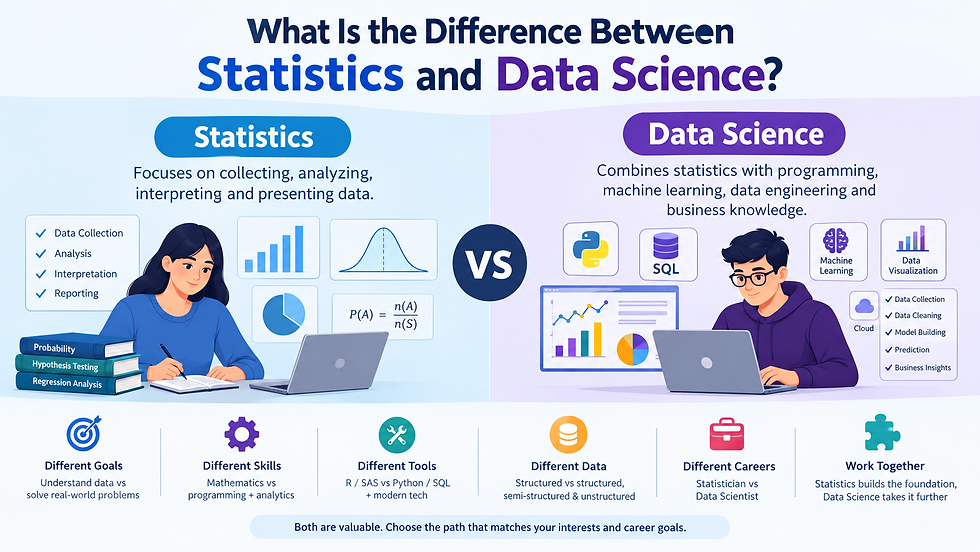
Understanding Statistics vs Data Science can help students and professionals choose the right learning path. Statistics mainly focuses on collecting, analyzing, interpreting, and presenting data, while data science combines statistics with programming, machine learning, data engineering, and business knowledge.
What Is Statistics?
Statistics is a mathematical field focused on collecting, organizing, analyzing, interpreting, and presenting data. It helps people understand patterns, relationships, trends, and uncertainty within datasets.
Statisticians use methods such as probability, hypothesis testing, regression analysis, sampling, and statistical modeling. These techniques are widely used in areas such as business, healthcare, economics, research, finance, and social sciences.
For example, a company may use statistics to analyze customer survey results and determine whether customers are satisfied with a particular product.
What Is Data Science?
Data science is a broader field that uses scientific methods, programming, statistics, machine learning, and analytical techniques to extract useful insights from structured and unstructured data.
A data scientist may collect data, clean it, explore patterns, create predictive models, and communicate results to decision-makers. Data science also involves working with large datasets and modern technologies such as Python, SQL, machine learning frameworks, cloud platforms, and data visualization tools.
For example, an online business can use data science to predict customer behavior and recommend products based on previous purchases.
Statistics vs Data Science: Key Difference
The main difference between statistics and data science is their scope and approach.
Statistics primarily focuses on understanding data through mathematical and statistical methods. Data science includes statistics but combines it with programming, machine learning, data engineering, visualization, and domain knowledge.
A statistician may focus on determining whether a result is statistically significant. A data scientist may use statistical analysis, programming, and machine learning together to predict future outcomes.
Therefore, statistics can be considered one of the important foundations of modern data science.
Difference in Skills and Knowledge
Statistics requires strong knowledge of mathematics, probability, statistical methods, and analytical reasoning. Professionals often work with statistical software and tools to analyze datasets.
Data science requires a wider technical skill set. Data scientists commonly need knowledge of:
Statistics and probability
Python or R programming
SQL and databases
Machine learning
Data visualization
Data cleaning
Big data concepts
Cloud technologies
Business and domain knowledge
This makes data science a multidisciplinary field that brings together several areas of expertise.
Difference in Tools and Technologies
Another important factor in Statistics vs Data Science is the technology used by professionals.
Statisticians may use tools such as R, SAS, SPSS, Excel, MATLAB, and statistical packages for analyzing data and building models.
Data scientists often use Python, R, SQL, Jupyter Notebook, machine learning libraries, cloud platforms, and data visualization tools. They may also work with technologies designed to process large volumes of data.
The choice of tools depends on the project, dataset, organization, and required analysis.
Difference in Data Handling
Statistics can be applied to small, medium, or large datasets, but traditional statistical analysis often emphasizes carefully designed datasets, samples, and experiments.
Data science generally works with a broader range of data sources. These can include databases, websites, applications, sensors, social media, customer transactions, and business systems.
Data scientists may also handle structured, semi-structured, and unstructured data. They use programming and data-processing techniques to prepare this information before analysis.
Difference in Machine Learning
Machine learning is another major difference between the two fields.
Statistics provides many concepts that support machine learning, including probability, regression, estimation, and statistical modeling. However, traditional statistics does not necessarily require machine learning.
Data science commonly uses machine learning to make predictions or automate decision-making. For example, a data scientist might develop a model to predict customer churn, detect fraudulent transactions, or recommend products.
Machine learning is therefore an important part of modern data science but is not the central requirement of every statistical project.
Difference in Business Applications
Statistics is widely used when organizations need to understand existing data, measure performance, test assumptions, or make decisions based on samples.
Data science has a broader range of business applications. Organizations use it for predictive analytics, recommendation systems, customer segmentation, fraud detection, forecasting, automation, and personalization.
For example, statistics can help a company determine whether a new marketing campaign improved sales. Data science can go further by building a model that predicts which customers are most likely to respond to future campaigns.
Statistics vs Data Science: Career Opportunities
Both fields offer valuable career opportunities, but their job roles can differ.
Statistics-related careers include:
Statistician
Statistical Analyst
Research Analyst
Biostatistician
Quantitative Analyst
Data science-related careers include:
Data Scientist
Data Analyst
Machine Learning Engineer
Data Engineer
Business Intelligence Analyst
The exact responsibilities vary between organizations. Professionals with strong statistical knowledge can also move into data science by developing programming and machine learning skills.
Which Is Easier to Learn?
The difficulty depends on a person's background and interests. Statistics can be challenging because it requires understanding mathematics, probability, and analytical concepts.
Data science can require an even broader learning path because students may need to understand statistics, programming, databases, visualization, machine learning, and business concepts.
Someone who enjoys mathematics and analytical reasoning may find statistics appealing. Someone interested in programming, technology, predictive models, and solving business problems may prefer data science.
Can a Statistician Become a Data Scientist?
Yes. A strong statistics background can provide an excellent foundation for becoming a data scientist.
Statisticians already understand probability, statistical modeling, data analysis, and research methods. To transition into data science, they can develop additional skills in Python, SQL, machine learning, data visualization, databases, and data-processing technologies.
Similarly, data scientists benefit from learning statistics because statistical thinking helps them understand data quality, uncertainty, relationships, experiments, and model performance.
How Statistics and Data Science Work Together
Statistics and data science are not competing fields. They often work together to solve complex data problems.
Statistics helps professionals understand the mathematical and analytical foundations behind data. Data science combines these principles with programming, machine learning, technology, and business knowledge.
For example, a data scientist may use statistical techniques to explore a dataset, Python to clean and process it, machine learning to build a predictive model, and visualization tools to communicate the results.
This combination makes data science highly useful for modern organizations.
Statistics vs Data Science: Which Should You Choose?
The right choice depends on your career goals.
Choose statistics if you are interested in mathematics, probability, research, experiments, statistical analysis, and interpreting data.
Choose data science if you want to combine statistics with programming, machine learning, technology, and business problem-solving.
Students who want flexibility can learn statistics first and then build data science skills. A strong understanding of statistics can make it easier to understand many concepts used in data science.
Conclusion:
The difference between statistics and data science mainly comes down to scope. Statistics focuses on mathematical and analytical methods for understanding data, while data science combines statistics with programming, machine learning, data technologies, visualization, and domain knowledge.
Understanding Statistics vs Data Science is important for anyone planning a career in data-related fields. Both disciplines are valuable, and they complement each other in modern data-driven environments. Whether you choose statistics or data science, developing strong analytical and problem-solving skills can create opportunities across many industries.
Frequently Asked Questions:
Is data science the same as statistics?
No. Statistics is primarily concerned with analyzing and interpreting data using mathematical and statistical methods. Data science is broader and combines statistics with programming, machine learning, data engineering, and business knowledge.
Which is better, statistics or data science?
Neither is universally better. Statistics is suitable for people interested in mathematical analysis and research, while data science is suitable for those interested in programming, machine learning, and solving practical data problems.
Is statistics important for data science?
Yes. Statistics is one of the fundamental areas of data science. Concepts such as probability, regression, sampling, distributions, and hypothesis testing are useful when analyzing data and evaluating models.
Can I become a data scientist after studying statistics?
Yes. Statistics graduates can transition into data science by developing programming, SQL, machine learning, data visualization, and data-processing skills.
Does data science require more programming than statistics?
Generally, yes. Data science commonly involves programming languages such as Python or R and tools for databases, machine learning, and data processing, while many statistics roles place greater emphasis on statistical analysis and mathematical methods.


Comments