What Is Machine Learning? A Complete Beginner’s Guide

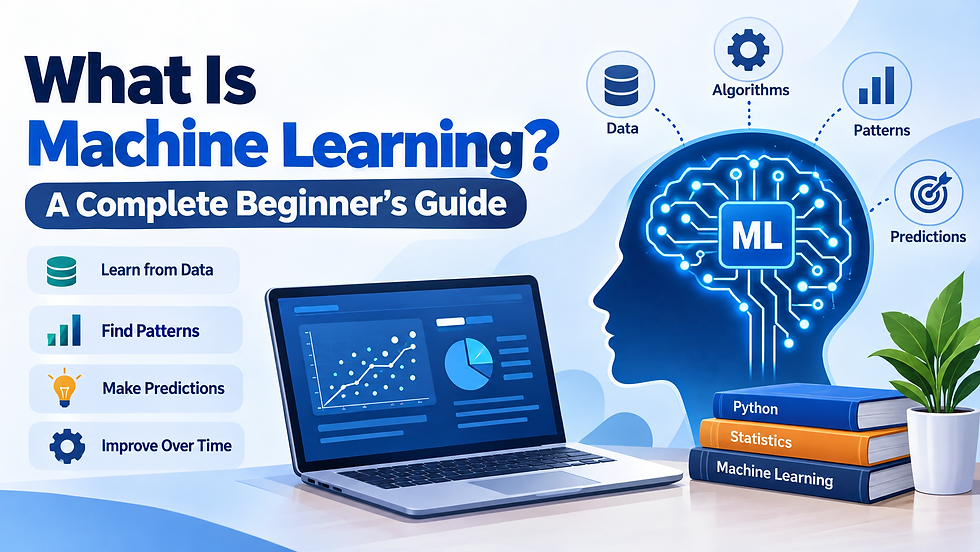
Machine learning has become one of the most important technologies behind modern digital applications. From personalized recommendations and voice assistants to fraud detection and autonomous systems, machine learning helps computers learn from data and improve their performance without being explicitly programmed for every task.
If you are wondering What Is Machine Learning, this beginner-friendly guide explains its meaning, how it works, major types, applications, benefits, limitations, and career opportunities.
What Is Machine Learning?
Machine learning (ML) is a branch of artificial intelligence (AI) that enables computers to learn patterns from data and make predictions or decisions based on those patterns. Instead of giving a computer detailed instructions for every possible situation, developers provide data and algorithms that allow the system to learn.
For example, an email system can analyze thousands of messages to identify patterns associated with spam. After learning from this data, it can predict whether a new email is likely to be spam.
In simple terms, machine learning allows computers to learn from experience and data.
How Does Machine Learning Work?
Machine learning generally follows a series of steps. First, data is collected from sources such as websites, applications, sensors, databases, or business systems. The data is then cleaned and prepared for analysis.
Next, a suitable machine learning algorithm is selected and trained using the available data. During training, the algorithm identifies patterns and relationships within the information.
The trained model is then tested using new data to evaluate its performance. If the results are satisfactory, the model can be deployed to make predictions or decisions.
The basic process includes:
Data collection
Data preparation
Model selection
Model training
Model evaluation
Model deployment
Continuous improvement
Why Is Machine Learning Important?
Machine learning is important because organizations generate enormous amounts of data every day. Traditional methods can make it difficult to analyze this information quickly and efficiently.
ML systems can process large datasets, identify hidden patterns, automate repetitive decisions, and generate useful predictions. Businesses use these capabilities to improve customer experiences, reduce costs, detect risks, and support decision-making.
Machine learning is also a major component of modern AI applications. As data availability and computing capabilities continue to increase, machine learning is becoming useful across industries such as healthcare, finance, retail, manufacturing, education, cybersecurity, and transportation.
Types of Machine Learning
There are three commonly discussed types of machine learning: supervised learning, unsupervised learning, and reinforcement learning. Each approach uses data differently depending on the problem being solved.
Supervised Learning
Supervised learning uses labeled data to train a machine learning model. The model receives input data along with the correct output and learns the relationship between them.
For example, a model can be trained using historical house data containing property features and their selling prices. After learning from the examples, it can estimate the price of a new property.
Common supervised learning applications include:
Spam detection
Price prediction
Image classification
Customer churn prediction
Credit risk assessment
Unsupervised Learning
Unsupervised learning works with data that does not have predefined labels. The algorithm attempts to discover patterns, groups, or relationships within the data.
A common example is customer segmentation. A business can provide customer information to an algorithm, which may identify groups of customers with similar behaviors.
Popular applications include:
Customer segmentation
Anomaly detection
Pattern discovery
Recommendation systems
Data exploration
Reinforcement Learning
Reinforcement learning allows an agent to learn by interacting with an environment. The system receives rewards for desirable actions and penalties for undesirable ones.
Over time, the agent learns a strategy that helps it maximize rewards. Reinforcement learning has applications in robotics, gaming, autonomous systems, and other decision-making environments.
Common Machine Learning Algorithms
Machine learning includes many algorithms designed for different types of problems. Some popular algorithms include linear regression, logistic regression, decision trees, random forests, support vector machines, k-nearest neighbors, and clustering algorithms.
More advanced machine learning applications may use neural networks and deep learning models.
The choice of algorithm depends on factors such as the size and quality of the dataset, the type of problem, desired accuracy, computational requirements, and how easily the results need to be explained.
There is no single machine learning algorithm that works best for every situation.
Machine Learning vs Traditional Programming
Traditional programming generally involves providing a computer with rules and data to produce an output. In machine learning, the system learns patterns from data to create a model that can produce predictions or decisions.
For example, a traditional program might use manually written rules to identify suspicious transactions. A machine learning system can instead learn from historical transaction data and identify patterns associated with potentially fraudulent activity.
This ability to learn from examples makes machine learning particularly useful for complex problems where writing rules for every possible situation would be difficult.
Real-World Applications of Machine Learning
Machine learning is already used in many everyday technologies and business processes.
Healthcare
ML can help analyze medical images, identify patterns in patient data, support diagnosis, and assist researchers in discovering potential treatments.
Finance
Financial institutions use machine learning for fraud detection, risk assessment, transaction monitoring, and customer analysis.
Retail
Retail companies can use ML for product recommendations, demand forecasting, inventory management, and customer segmentation.
Cybersecurity
Machine learning can identify unusual network behavior, detect potential threats, classify suspicious activity, and support security monitoring.
Transportation
ML contributes to route optimization, traffic prediction, demand forecasting, and autonomous driving technologies.
Education
Educational platforms can use machine learning to personalize learning experiences, analyze student performance, and recommend relevant learning resources.
Benefits of Machine Learning
Machine learning offers several important benefits for organizations and individuals.
Automation: ML can automate repetitive tasks and reduce manual effort.
Better predictions: Models can analyze historical information to identify trends and make predictions.
Scalability: Machine learning can process large amounts of data efficiently.
Personalization: Businesses can provide customized recommendations and experiences.
Faster decision-making: ML-powered systems can analyze information quickly and support data-driven decisions.
Continuous improvement: Some machine learning systems can be updated with new data to improve their performance over time.
Limitations of Machine Learning
Although machine learning offers significant advantages, it also has limitations. Models depend heavily on the quality and relevance of their training data. Poor-quality or biased data can produce unreliable results.
Developing and maintaining ML systems can also require specialized knowledge, computing resources, and ongoing monitoring. Some advanced models can be difficult to interpret, making it challenging to understand exactly why a particular prediction was produced.
Privacy, security, fairness, and responsible use are additional considerations when machine learning is applied to sensitive information.
What Skills Are Needed to Learn Machine Learning?
People interested in machine learning can begin by developing a combination of technical and analytical skills.
Important skills include:
Python programming
Mathematics
Statistics
Data analysis
Data visualization
SQL
Machine learning algorithms
Model evaluation
Problem-solving
Basic understanding of AI
Python is particularly popular because it has many libraries and frameworks for data analysis and machine learning. Beginners can start with programming fundamentals before progressing to statistics, data preparation, algorithms, and practical ML projects.
Career Opportunities in Machine Learning
Machine learning knowledge can support several technology careers. Depending on their interests and experience, professionals can explore roles such as machine learning engineer, data scientist, AI engineer, data analyst, research scientist, or business intelligence professional.
A strong foundation in programming, mathematics, statistics, and data handling can help beginners build toward these careers.
Practical projects are also valuable because they demonstrate the ability to apply theoretical concepts to real-world problems.
What Is the Future of Machine Learning?
The future of machine learning is closely connected with the growth of artificial intelligence, automation, big data, and cloud computing. Organizations are increasingly using ML to understand information, automate processes, and build intelligent applications.
Machine learning is also becoming more accessible through cloud platforms, development frameworks, and pre-trained models. At the same time, responsible AI practices, data privacy, transparency, and model security are becoming increasingly important.
As technology develops, machine learning is expected to remain an important part of digital innovation.
Conclusion:
Understanding What Is Machine Learning provides a foundation for exploring artificial intelligence and modern data-driven technology. Machine learning enables computers to learn from data, identify patterns, make predictions, and improve performance without requiring every rule to be manually programmed.
From healthcare and finance to cybersecurity, retail, and education, ML has practical applications across many industries. For beginners, learning Python, statistics, mathematics, data analysis, and fundamental machine learning algorithms can provide a strong starting point for building practical skills and exploring future career opportunities.


Comments