How to Become a Data Scientist: Skills You Need to Learn First

Introduction
Data Science is one of the fastest-growing and highest-paying career fields in the world. Businesses across healthcare, finance, e-commerce, manufacturing, and technology rely on data scientists to analyze data, predict trends, and make informed decisions. If you're wondering how to become a data scientist, the journey begins with learning the right foundational skills.
This guide explains the essential skills every aspiring data scientist should learn first, the recommended learning path, and practical tips to help you build a successful career.
What Does a Data Scientist Do?
A data scientist collects, processes, analyzes, and interprets large datasets to solve business problems. They combine programming, statistics, mathematics, and machine learning to discover valuable insights from data.
Typical responsibilities include:
Collecting and cleaning raw data
Analyzing datasets
Building predictive models
Creating dashboards and reports
Developing machine learning solutions
Communicating insights to stakeholders
Why Choose Data Science as a Career?
Data Science offers excellent career growth and attractive salaries.
Benefits include:
High demand across industries
Competitive salary packages
Opportunities to work with AI and Machine Learning
Remote and global career options
Continuous learning and innovation
Diverse job roles
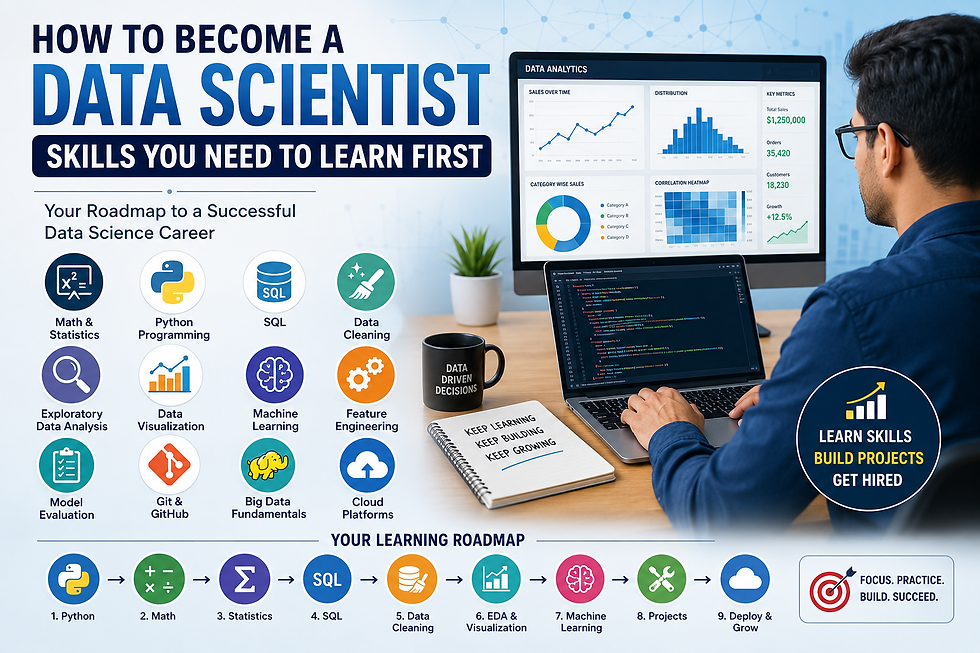
Skills You Need to Learn First
1. Mathematics and Statistics
Mathematics forms the foundation of Data Science.
Focus on learning:
Probability
Statistics
Linear Algebra
Calculus
Hypothesis Testing
Correlation and Regression
These concepts help you understand machine learning algorithms and interpret data correctly.
2. Python Programming
Python is the most popular programming language for Data Science because of its simplicity and extensive libraries.
Learn:
Variables
Loops
Functions
Object-Oriented Programming
File Handling
Exception Handling
Important Python libraries:
NumPy
Pandas
Matplotlib
Seaborn
Scikit-learn
3. SQL
Almost every company stores information in databases.
You should learn:
SELECT statements
Filtering
Joins
GROUP BY
HAVING
Window Functions
Subqueries
Strong SQL skills are essential for retrieving and preparing data.
4. Data Cleaning
Real-world data is often incomplete and inconsistent.
Learn how to:
Remove duplicates
Handle missing values
Detect outliers
Standardize data
Normalize datasets
Data cleaning is one of the most valuable skills for any data scientist.
5. Exploratory Data Analysis (EDA)
EDA helps uncover patterns before building models.
Techniques include:
Data visualization
Summary statistics
Correlation analysis
Distribution analysis
Feature relationships
Python libraries such as Pandas, Seaborn, and Matplotlib are widely used for EDA.
6. Data Visualization
Visualization makes complex information easy to understand.
Popular tools include:
Matplotlib
Seaborn
Plotly
Tableau
Power BI
Good visualizations improve business decision-making.
7. Machine Learning Basics
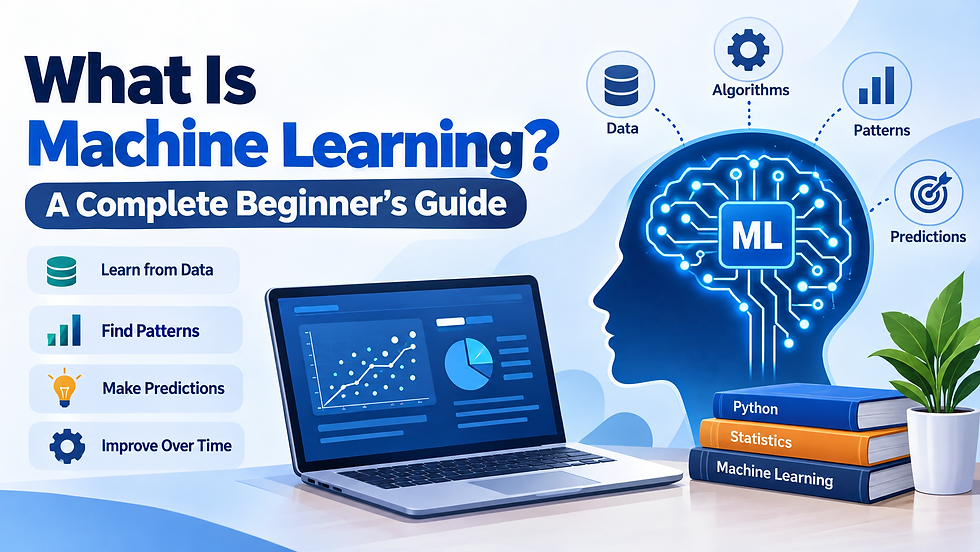
Machine Learning enables computers to learn from data.
Start with:
Supervised Learning
Linear Regression
Logistic Regression
Decision Trees
Random Forest
Support Vector Machine
Unsupervised Learning
K-Means Clustering
Hierarchical Clustering
PCA
Understand when and why each algorithm is used.
8. Feature Engineering
Feature engineering improves model performance by creating meaningful input variables.
Learn techniques such as:
Encoding categorical variables
Scaling features
Feature selection
Feature extraction
Better features often lead to better predictions.
9. Model Evaluation
A good data scientist knows how to evaluate models properly.
Important metrics include:
Accuracy
Precision
Recall
F1 Score
ROC-AUC
Mean Absolute Error (MAE)
Root Mean Square Error (RMSE)
10. Git and GitHub
Version control helps manage projects efficiently.
Learn:
Git basics
Branching
Commits
Pull Requests
Repository management
GitHub also serves as your professional portfolio.
11. Big Data Fundamentals
Many organizations process massive datasets.
Become familiar with:
Hadoop
Spark
Distributed Computing
Cloud Storage
Although beginners don't need deep expertise, understanding these technologies is beneficial.
12. Cloud Platforms
Modern Data Science frequently uses cloud computing.
Popular platforms include:
AWS
Microsoft Azure
Google Cloud Platform (GCP)
Learn how machine learning models are deployed in cloud environments.
Recommended Learning Roadmap
Follow this sequence:
Python Programming
Mathematics
Statistics
SQL
Data Cleaning
Data Visualization
Exploratory Data Analysis
Machine Learning
Feature Engineering
Deep Learning Basics
Cloud Computing
Build Real Projects
Following this roadmap ensures a strong foundation before moving to advanced topics.
Build Practical Projects
Employers value practical experience.
Begin with projects like:
Sales Prediction
House Price Prediction
Customer Segmentation
Movie Recommendation System
Spam Email Detection
Stock Price Analysis
Sentiment Analysis
Fraud Detection
Publish these projects on GitHub to showcase your skills.
Create an Impressive Portfolio
Your portfolio should include:
GitHub repositories
Kaggle notebooks
Machine learning projects
Dashboards
Technical blogs
Resume
LinkedIn profile
A strong portfolio often matters more than certificates alone.
Recommended Learning Resources
You can learn through:
Online Data Science courses
YouTube tutorials
Kaggle competitions
Open-source datasets
Python documentation
SQL practice websites
Machine Learning books
Consistency is more important than learning from many different sources.
Common Mistakes Beginners Should Avoid
Avoid these common errors:
Skipping Python fundamentals
Ignoring statistics
Memorizing algorithms without understanding them
Avoiding real projects
Not practicing SQL
Neglecting data cleaning
Building models without EDA
Failing to document projects
Learning systematically produces better long-term results.
Career Opportunities After Learning Data Science
After mastering the required skills, you can apply for roles such as:
Data Scientist
Data Analyst
Machine Learning Engineer
Business Intelligence Analyst
AI Engineer
Data Engineer
Research Scientist
Analytics Consultant
These roles are available across startups, multinational companies, and government organizations.
Salary of a Data Scientist
Data Scientist salaries vary depending on experience, location, and skills.
Typical progression:
Entry Level: Competitive starting salary
Mid-Level: Significant salary growth with project experience
Senior Level: High earning potential in leadership or specialized AI roles
Professionals with expertise in Python, SQL, Machine Learning, and Cloud technologies generally command higher salaries.
Final Thoughts:
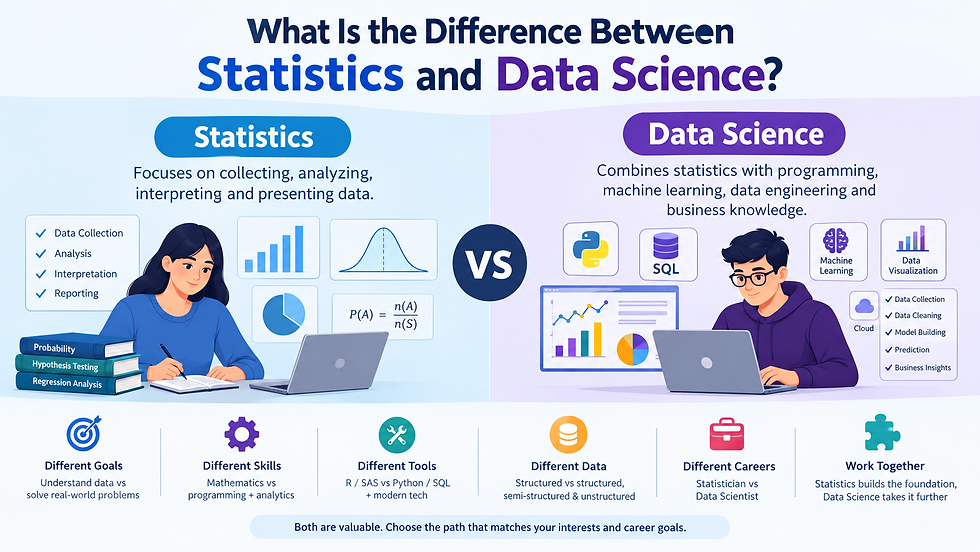
Becoming a data scientist requires dedication, curiosity, and continuous practice. Start by mastering Python, mathematics, statistics, SQL, and data analysis before moving into machine learning and cloud technologies. Build practical projects, maintain an active GitHub portfolio, and keep learning as the field evolves.
With the right learning path and consistent effort, you can build a rewarding career in Data Science and contribute to solving real-world problems using data.
Read More Details: Skills Required for Data Scientist

Comments